





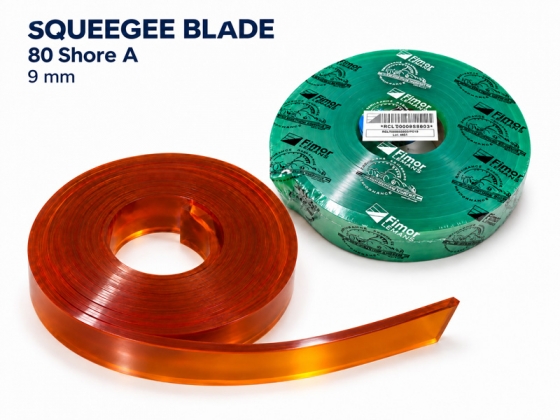
Screen printing squeegee blade 9mm 80 Shore A
- Rigid blade
- Controlled ink deposition
- Supports sharp print reproduction
- Suitable for halftone details
Product details
The squeegee blade directly contacts the screen mesh during screen printing, wiping and forcing ink through the image areas of the stencil onto the substrate. Selecting the appropriate hardness helps control ink transfer through the mesh and the definition of the printed image.
With a thickness of 9 mm and a hardness of 80 Shore A, this product is suitable for jobs that prioritize blade rigidity, controlled ink deposition and detail reproduction.
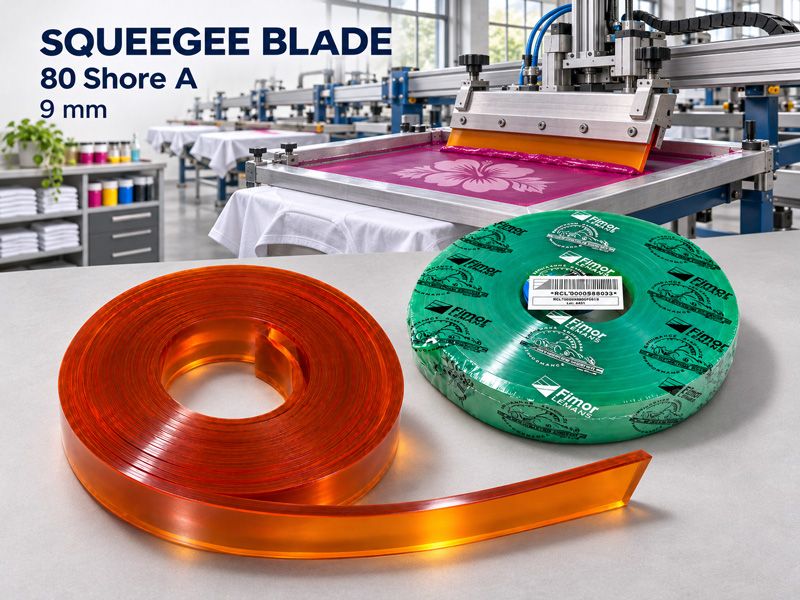
Key Features
Hard blade with reduced flex during printing
Compared with a softer squeegee blade under the same operating conditions, an 80 Shore A blade exhibits less flex. This characteristic suits jobs requiring blade rigidity and control over the amount of ink deposited onto the substrate.
Supports fine-line and halftone reproduction
An 80 Shore A squeegee blade is commonly selected for fine lines, halftone details and CMYK process printing. Actual results also depend on the condition of the blade edge, mesh count, stencil and press settings.
Suitable for jobs requiring controlled ink deposition
Under otherwise equivalent conditions, a harder squeegee blade generally deposits less ink than a softer blade. This is useful when a thin ink deposit and clearly defined details are required. Jobs requiring heavier ink deposits should be tested to determine the appropriate blade hardness.
Technical Specifications
|
Item |
Specification |
|
Product name |
Screen printing squeegee blade |
|
Product code |
Squeegee Blade 9mm-80A |
|
Thickness |
9 mm |
|
Hardness |
80 Shore A |
|
Classification |
Hard squeegee blade |
|
Function |
Wiping ink and controlling ink deposition |
|
Applications |
Textile and graphic screen printing |
|
Compatible equipment |
Manual and automatic screen printing presses |
Applications
▫ Textile screen printing: Designs featuring small text, fine lines, halftone details or process-color separations.
▫ Graphic screen printing: Designs requiring controlled ink deposition and clear image definition.
▫ Use with plastisol, UV-curable and solvent-based inks: Select the blade according to the chemical resistance of the specific material grade.
A hardness of 80 Shore A does not indicate resistance to every type of ink or solvent. Manufacturers use different material formulations for conventional ink systems and more chemically aggressive ink systems.
Use and Storage Guidelines
▫ Select a handle or blade holder suitable for a 9 mm thick blade. Secure the blade firmly without forcing it into the holder.
▫ Run print trials to adjust the squeegee angle, pressure and speed to suit the ink, mesh and substrate.
▫ Remove ink after use with a suitable cleaning agent.
▫ Allow the blade to dry and recover after chemical exposure before reuse or sharpening.
▫ Inspect the blade edge regularly. Store the blade without bending it or placing any load on the printing edge.
Proper cleaning, rotation between blades and maintenance of the printing edge help reduce deformation and support consistent print quality.
