





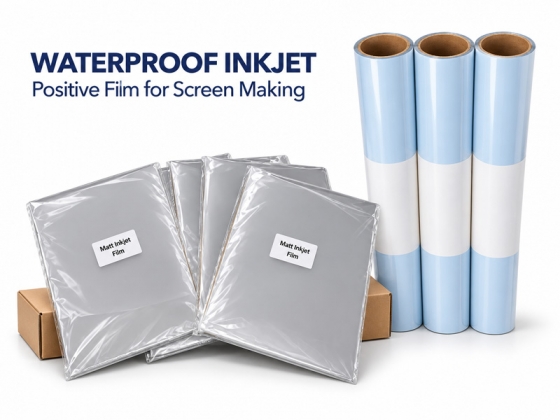
Waterproof inkjet positive film for screen making
- Supports high black density
- Sharp reproduction of fine lines
- Reduces ink bleeding after printing
- Various sizes and formats available
Product details
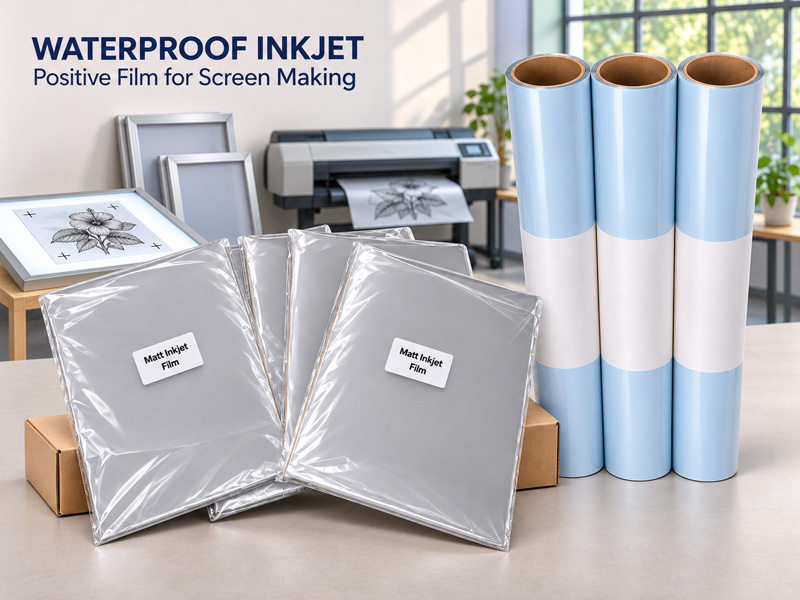
Waterproof inkjet positive film is an imaging consumable used in screen making. Artwork is printed onto its specially coated surface using an inkjet printer. The printed film then serves as an exposure mask for a screen coated with photosensitive emulsion.
The black image areas block light, while the background allows light to pass through. This difference determines which areas of the emulsion harden and which are washed out to form the stencil image.
Key Features
1. Dedicated ink-receptive coating
The coating receives and holds inkjet ink, helping maintain image integrity and reduce bleeding once the ink has dried. Film output quality depends on compatibility between the coating, ink system and printer settings.
2. Supports opaque black image areas
The film is used to produce black image areas for screen exposure. Black density and UV opacity must be sufficient to protect the emulsion areas that should remain unexposed. Visible darkness alone should not be used to assess light-blocking performance.
3. Reproduces fine details and halftone dots
With a suitable combination of printer, ink and output settings, the film supports the reproduction of fine lines, small text and halftone dots for screen making. Film positive quality is an important factor in producing a good stencil.
4. Compatible with suitable dye and pigment inks
According to the supplied product information, the film supports both dye-based and pigment-based inks. However, confirm the specific film grade and ink system before use, as ink receptivity depends on the coating of each film type.
5. Various formats available
Sheet and roll options allow artwork layouts to be arranged according to the printer format and required screen size.
Product Specifications
|
Item |
Information |
|
Product name |
Inkjet positive film for screen making |
|
Application |
Producing film positives for screen exposure |
|
Base material |
PET film |
|
Types |
Waterproof / Non-waterproof |
|
Appearance |
Milky white or clear, depending on the version |
|
Thickness |
115 µm, 120 µm, 130 µm and other available specifications |
|
Sheet sizes |
A4, A3, A3+, A2 |
|
Roll widths |
0.432 / 0.61 / 0.914 / 1.07 m |
|
Roll lengths |
30 m or 50 m |
|
Compatible ink systems |
Dye or pigment, depending on the film grade |
Applications
▫ Producing colour separation film positives for textile and garment screen printing
▫ Screen making for line artwork, small text, logos and patterns
▫ Producing halftone film positives where the printer, ink and software meet the requirements
▫ Preparing film positives for suitable graphic screen printing applications
Directions for Use
1. Prepare the artwork
Check image dimensions, colour separations, halftone dots and registration marks. Set the image orientation so that the printed side of the film can contact the emulsion directly during exposure.
2. Print the film
Identify the correct ink-receptive side. Select suitable media settings and ink deposition according to the film, printer or RIP software instructions.
3. Allow the ink to dry completely
Check the image, black areas and ink dryness before exposure. Ulano recommends that film positives should not be used until the ink is completely dry.
4. Expose the screen
Place the printed side of the film in close contact with the dried emulsion. Expose using suitable equipment, with the exposure time established through an exposure test.
5. Wash out the stencil
Wash away the unhardened emulsion beneath the light-blocking image areas to create openings through which ink can pass. Inspect and dry the screen before use.
Care and Storage
Keep the film clean, dry and flat. Protect the ink-receptive surface from dust, fingerprints and scratches. Store in sealed packaging under the conditions recommended by the supplier.
Note: The term “waterproof” does not mean that the printed film can be immersed in water or washed. Some inkjet films primarily offer bleed resistance, and dye inks may bleed again when exposed to water. Keep printed film positives dry and verify the properties of the specific film grade being used.
