





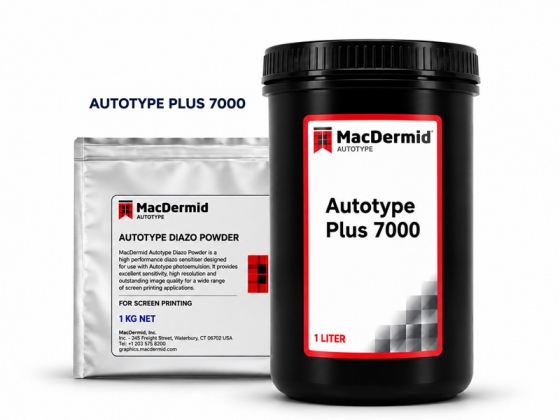
Autotype PLUS 7000 dual-cure screen printing emulsion
- Resists water-based, solvent-based and UV-curable inks
- High resolution and sharp edge definition
- Excellent stencil durability during printing
- Easy stencil removal after printing
Product details
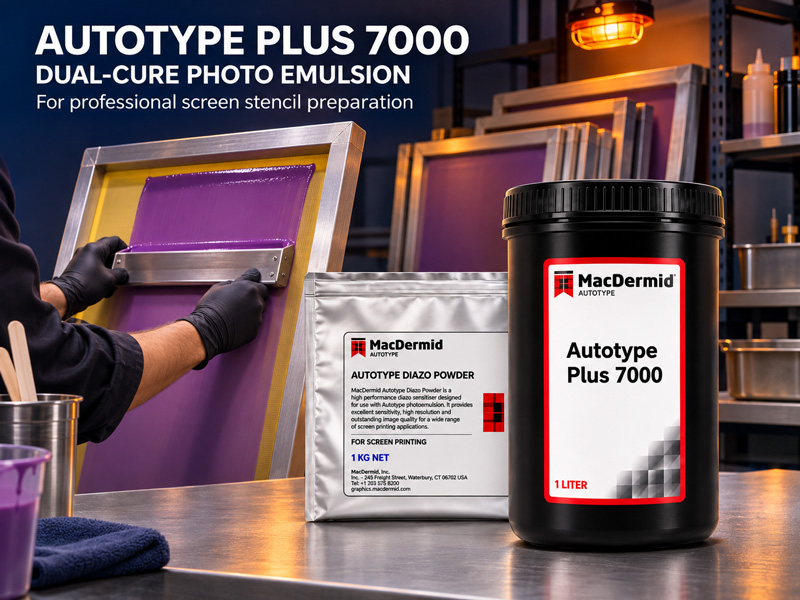
Autotype PLUS 7000 is a dual-cure photoemulsion that uses a diazo sensitiser to produce screen printing stencils. The emulsion is coated onto the mesh, dried, exposed and developed with water to form a stencil that blocks non-image areas while leaving image areas open for ink transfer onto the substrate.
The product combines resistance to multiple ink systems with high resolution, sharp edge definition and stencil durability. PLUS 7000 is suitable for applications requiring consistent quality over long print runs, while allowing convenient stencil removal so the mesh can be reused.
Key features
1. Resistance to water-based, solvent-based and UV-curable inks
PLUS 7000 resists a wide range of water-based, solvent-based and UV-curable inks, offering flexibility in emulsion selection for different print applications.
Compatibility should be checked with the actual inks and cleaning chemicals used to ensure satisfactory performance.
2. High resolution and sharp edge definition
The product supports clear reproduction of fine details and well-defined image edges, making it suitable for designs requiring high precision.
Optimal stencil quality depends on appropriate mesh selection, control of emulsion coating thickness and correct exposure.
3. Durable stencils with good moisture resistance
PLUS 7000 produces durable stencils suitable for long print runs. Its good water resistance also helps reduce stencil softening in high-humidity environments.
To achieve the required durability, the stencil must be thoroughly dried and fully exposed before production.
4. Wide processing latitude
The emulsion offers wide processing latitude, providing greater flexibility and easier control during stencil production.
Exposure tests are still necessary to determine the appropriate exposure time for the equipment, mesh and actual stencil thickness.
5. Easy stencil removal and screen reclaiming
After printing, the stencil can be removed with suitable reclaiming chemicals so the mesh can be reused.
This allows PLUS 7000 to meet both the need for durability during printing and the requirement for convenient screen reclaiming after production.
Technical information
|
Parameter |
Details |
|
Product name |
Autotype PLUS 7000 |
|
Type |
Dual-cure screen printing emulsion |
|
Sensitiser |
Diazo powder |
|
Solids content after sensitising |
34% |
|
Colour |
Blue |
|
Compatible ink systems |
Water-based, solvent-based and UV-curable inks |
|
Main applications |
Electronics and industrial printing |
|
Reclaimability |
Stencil can be removed after printing using suitable reclaiming chemicals |
Applications
1. Electronics printing
Suitable for stencil-making applications requiring high resolution, sharp edge definition and controlled print quality. Mesh and stencil thickness should be selected according to the requirements of each product.
2. Industrial printing
Suitable for applications requiring durable stencils, resistance to compatible ink systems and consistent quality throughout production.
3. General-purpose screen printing
Can be selected for various applications using water-based, solvent-based or UV-curable inks, particularly where image quality, stencil durability and easy stencil removal are required together.
Instructions for use
1. Mesh preparation
Degrease, rinse thoroughly and dry the mesh before coating.
2. Sensitising
Add the supplied diazo powder directly to the emulsion; do not dissolve it beforehand or add water. Stir thoroughly for approximately 2–3 minutes, then leave the emulsion overnight to allow air bubbles to escape.
3. Coating
Suggested coating sequence: two coats on the print side, followed by two coats on the squeegee side. Adjust according to stencil requirements.
4. Drying
Place the screen horizontally with the squeegee side facing upwards, in darkness or under yellow safelight conditions. The drying temperature must not exceed 30°C.
5. Exposure and washout
Carry out an exposure test to determine the appropriate exposure time. After exposure, wash both sides thoroughly until the image areas are fully open.
6. Stencil finishing
Dry at a temperature not exceeding 30°C. Inspect the stencil and touch up any pinholes before printing.
Storage and handling notes
According to the referenced technical data sheet (TDS), store the unsensitised emulsion and diazo at 5–20°C. The stated shelf life is 24 months before sensitising and 4–6 weeks after sensitising; check these details against the current product label.
Record the sensitising date and follow the accompanying safety instructions. Do not apply diazo mixing instructions intended for other products to PLUS 7000.
