





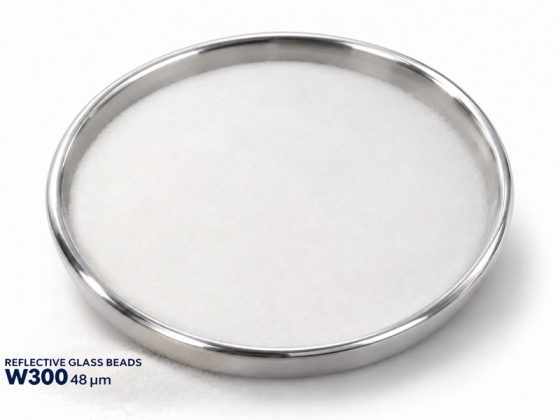
Reflective glass beads W300 48μm
- Returns light toward its source
- 48 µm particle size
- Adds visual impact to prints
- Suitable for textile decoration
Product details
W300 retroreflective glass beads are fine particles with a size of 48 µm. When incorporated into a suitable ink or coating system, they produce retroreflection, returning incident light toward its source.
The product does not glow independently in the dark. The retroreflective effect becomes visible when the print is illuminated by lamps, vehicle headlights, or another suitable light source.
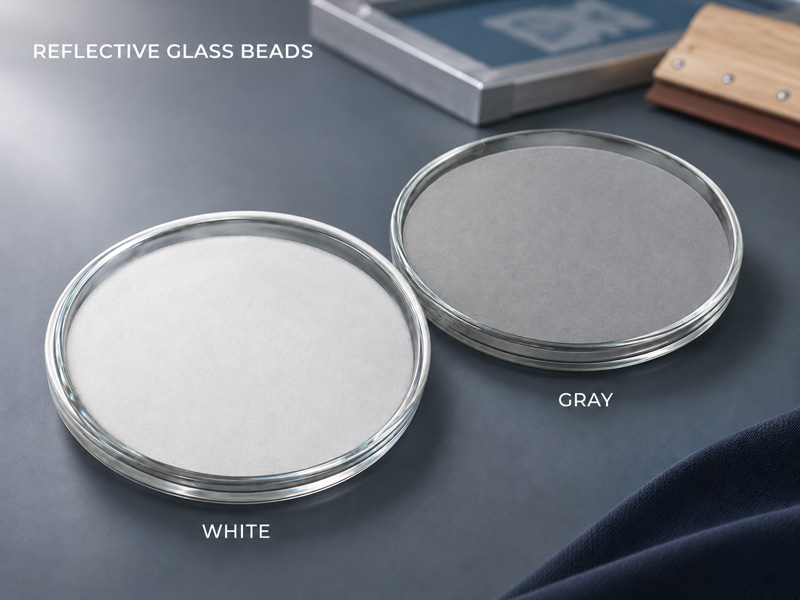
Key Features
1. Retroreflective Effect
Unlike a conventional metallic effect, retroreflection returns light approximately toward its source. This can make the design appear brighter when viewed from a position close to the light source.
2. Fine Particle Size
With a stated particle size of 48 µm, W300 is intended for reflective ink and textile decoration applications. Surface smoothness and effect uniformity also depend on particle size distribution, dispersion, and the resulting printed ink layer.
3. Suitable for Reflective Ink Development
Glass beads are used in printing inks, coatings, and retroreflective textile materials. Different bead grades may vary in refractive index, surface coating, and application configuration, so the appropriate grade must be selected for each ink system.
4. Visual Effects for Fashion Products
The beads can be used to develop retroreflective logos, lettering, and patterns on textile products when combined with a suitable binder and process.
Product Information
|
Item |
Information |
|
Product name |
Retroreflective Glass Beads |
|
Product code |
W300 |
|
Stated particle size |
48 µm |
|
Material |
Glass |
|
Optical property |
Retroreflection when illuminated |
|
Self-luminous |
No |
|
Unit of sale |
kg |
Screen Printing Applications
▫ Formulation of reflective inks for compatible screen printing systems
▫ Printing logos, lettering, and patterns on fashion garments
▫ Decoration of sportswear, footwear, and accessories
▫ Retroreflective details on craft products
▫ Development of visibility-enhancing details on workwear, subject to finished-product performance testing
Factors Affecting Retroreflective Performance
Retroreflective performance depends on more than particle size. Refractive index, bead shape, surface characteristics, and the portion of each bead exposed to incident light all influence the result.
For screen printing applications, also check:
▫ Compatibility between the beads and binder
▫ Dispersion, ink layer thickness, and layer structure
▫ Mesh opening size and the mixture’s ability to pass through the screen
▫ Drying and curing conditions, and adhesion to the substrate
General Instructions for Use
1. Confirm the Material System
Check the bead grade, ink or binder system, and method of incorporating the beads into the printed layer according to the supplier’s instructions.
2. Prepare a Test Sample
Mix or apply a small quantity using a confirmed formulation. Do not adopt mixing ratios specified for other products without verification.
3. Select the Screen
Select the mesh according to its opening size, the largest particle size, and the mixture’s properties. Do not directly convert 48 µm into a fixed mesh count.
4. Print and Finish
Test-print on the actual substrate, then dry or cure according to the ink and binder system’s instructions.
5. Evaluate the Finished Product
Check the effect under suitable lighting, adhesion, hand feel, and wash or rubbing fastness according to the intended use.
Storage and Precautions
Keep the packaging tightly closed, clean, and dry, and prevent contamination. Follow the storage and handling instructions in the product’s safety data sheet.
No verified W300-specific data are currently available for mixing ratios, refractive index, curing conditions, or wash fastness. These specifications should not be published without supporting documentation.
For protective clothing or products requiring compliance with retroreflective performance standards, test the finished product against the applicable requirements. Adding glass beads alone does not guarantee compliance.
